
Potassium, Constipation and Sleep
Constipation is complex and has many causes, but potassium seems to be often overlooked — it can also be a huge factor in night waking

In this post
The “99 mg FDA limit” isn’t as scary as it sounds.
Low potassium slows gut motility and is a cause of constipation.
Smaller amounts may do little but large single doses are best avoided.
Potassium deficiency is not rare, even when diet seems reasonable.
Potassium supplementation can hugely improve night waking.
I would only take capsules with or very soon after food.
Size of dose matters
We need to clear this up first.
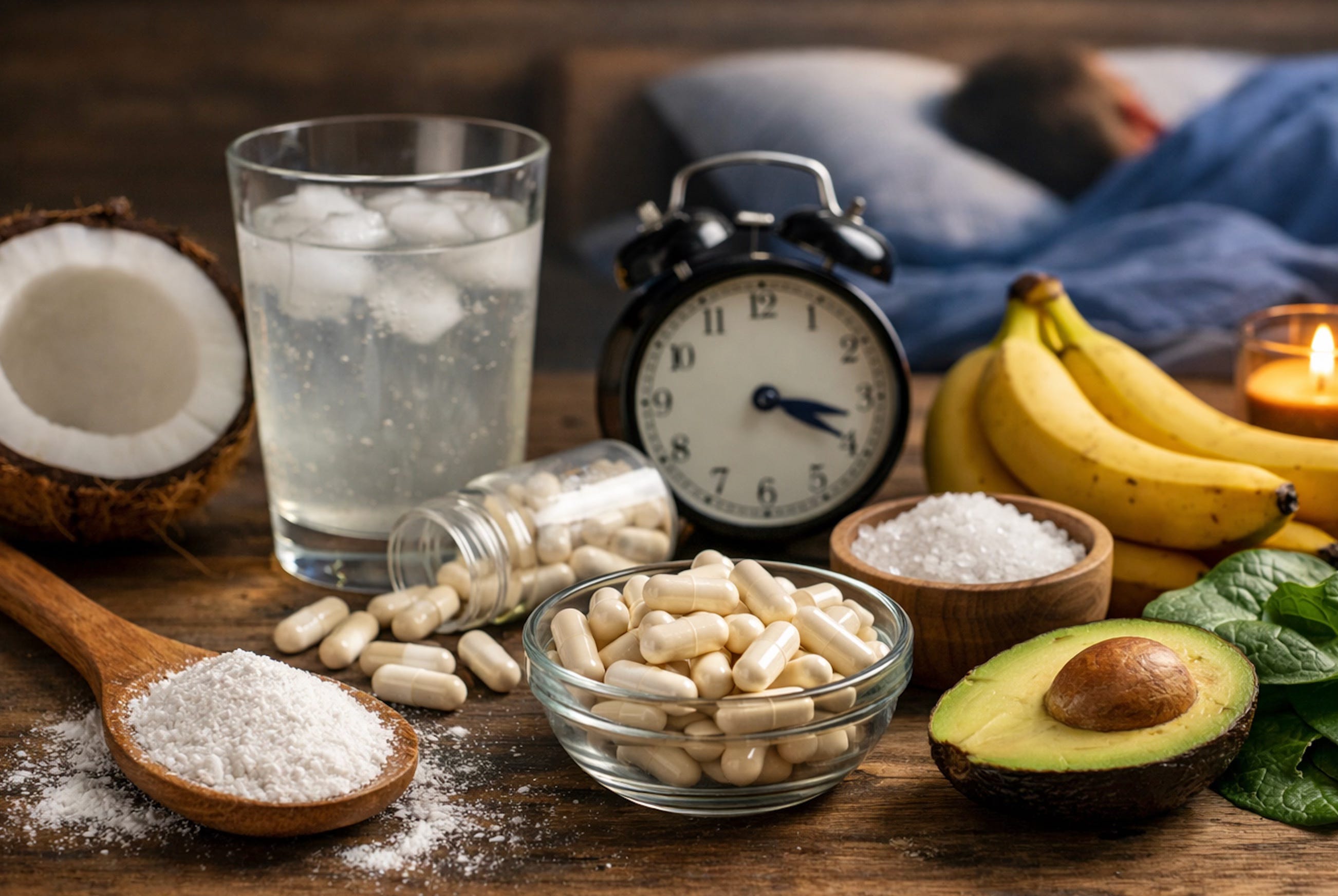
Too little may do nothing, and too much can be harmful, but there is no need to panic. There’s more headroom in “too much” than many people think.
It’s important to understand what “too much” actually means. For context, a glass of coconut water contains about 600 mg of potassium.
Potassium capsules are sold in 99 mg doses because, under US FDA regulations, tablets containing 100 mg or more of potassium per tablet could face regulatory action unless they are prescription-labelled and carry specific warnings.
Which makes people think 99 mg must be a good-sized dose. It’s not. Here are the US Adequate Intakes:
Adults:
Men 19+: 3,400 mg/day — Women 19+: 2,600 mg/day
Children:
1–3 years: 2,000 mg/day
4–8 years: 2,300 mg/day
Boys 9–13: 2,500 mg/day — Girls 9–13: 2,300 mg/day
Boys 14–18: 3,000 mg/day — Girls 14–18: 2,300 mg/day
So for a four-year-old, if they were to get their full intake from supplements, that would be 23 capsules. And remember, this is “adequate” intake. It says nothing about what someone who is already deficient might need.
The Linus Pauling Institute page on potassium says “Oral doses of potassium >18 g taken at one time in individuals not accustomed to high intakes may lead to severe hyperkalemia” (hyperkalemia means a toxic level of potassium). 18 grams is ~180 caps in one go (or three and a third tablespoons of Now Foods, Potassium Citrate). Even if the toxic dose was a quarter of that in a child, that’s ~45 capsules in one go.
Why does the FDA limit to 99 mg per dose?
The short version is that older, solid potassium chloride tablets could dissolve in one spot, creating a high local concentration, and chemically injuring the intestinal lining.
The problem was even worse with some older formulations, especially enteric-coated potassium chloride (enteric coating resists breakdown in the stomach).
But here we’re not talking about solid, large dose tablets. We’re talking about powder in capsules, taken with food, or else mixed into a drink. Tablets can sit against the gut wall and slowly dissolve. A powder in a capsule doesn’t behave that way.
For example, Now Foods, Potassium Citrate, Pure Powder shows a serving size of a quarter of a level teaspoon giving 448 mg of elemental potassium. How can they show a dose larger than 99 mg? Because it’s not a tablet!
I would always avoid potassium tablets.
I would also always take any capsules (anything not a liquid) with or very soon after food.
Dose confusion: supplement vs. prescription
I’ve personally come across dosing confusion among medical professionals, which seems to stem from potassium being measured in two different ways: one for supplements and one for prescriptions.
When you buy a supplement, the label shows the amount of elemental potassium. That means the amount of actual potassium in a serving (usually a capsule).
But when potassium is prescribed as a medicine, the dose is usually given in mEq (milliequivalents). To convert mEq into milligrams of potassium (it varies by substance):
1 mEq = 39.1 mg of elemental potassium
That means a standard 20 mEq prescription dose of potassium is equal to 782 mg of elemental potassium. And eight 99 mg capsules is 792 mg.
When doctors want to prevent low potassium in a child, they use a dose of 1 to 2 mEq/kg, up to 20 mEq. In other words, they prescribe the equivalent of about eight capsules.
But because they’re trained not to give more than “one dose”, they only recommend “one dose” = “one capsule”, maximum, of a supplement.
Why might autistic children need more potassium?
Many autistic children have what’s referred to as “sluggish gut”, which sounds like ileus. Wikipedia says: “Ileus is a disruption of the normal propulsive ability of the intestine due to the malfunction of peristalsis.” Most causes of ileus are pretty esoteric except one: lack of potassium (hypokalemia). (I know Wikipedia has issues, but I think it’s fine for a quick overview of factual topics.)
From Wikipedia, on hypokalemia: “Symptoms may include feeling tired, leg cramps, weakness, and constipation.”
Constipation is very common among autistic children.
Also from Wikipedia: “Hypokalemia is one of the most common water–electrolyte imbalances. It affects about 20% of people admitted to hospital.”
So it’s not as if being low in potassium is at all unusual.
How much should be supplemented?
There isn’t a clear answer. This isn’t a drug; it’s an essential mineral (“essential” meaning, without it we’d die).
Personally, I’d avoid giving large single doses. What’s “large”? Perhaps no more than about a third of the Adequate Intake — but, again, this is not a drug; it’s a supplement.
Can’t it come from food?
It absolutely is coming from food! It’s in very many foods, but as mentioned above, it’s perfectly possible to be low in it, and it’s surprisingly easy to not be getting enough for your needs in your diet.
I’m not going to get into which foods have more or less potassium. That’s what AIs are for. Here I’m only covering potassium supplementation and how it can directly and rapidly affect constipation and sleep.
What I’ve seen with constipation
I’ve not seen an improvement in constipation with less than 300 mg. I’ve also used 750 mg mixed into a pint of water consumed over a couple of hours. Remember, that is roughly the same amount of potassium as one and a half glasses of coconut water.
We use Now Foods, Potassium Citrate, Pure Powder as it’s the cheapest and easiest to dose.
With around 700 mg, my son went after pretty much every meal!
Note: Potassium supplementation is certainly not the only answer to constipation. Constipation can have very many causes (probably several may be in play in one person), but it appears to be a badly overlooked one.
Potassium and night waking
This has been one of the biggest game-changers we’ve ever found for our son. Far less waking and far easier to return to sleep if he does wake up. I had no idea of that effect and was only supplementing it for constipation. It was only after a few days that I realised his sleep had improved.
I’ve since come across the phrase “Magnesium for falling asleep. Potassium for staying asleep”.
This study showed earlier sleep onset and less daytime sleepiness (which suggests better quality sleep): Sleep Symptoms Associated with Intake of Specific Dietary Nutrients
And in the study Potassium affects actigraph-identified sleep it found that in male children: “Potassium significantly increased actigraphic Sleep Efficiency (p less than 0.05) due to a reduction in actigraphic Wake after Sleep Onset (WASO) (p less than 0.05).”